Maggie & Oliver or A Bone of One’s Own

Maggie & Oliver or A Bone of One’s Own by Jennifer Thermes

I grabbed this off the new books shelf at my local library because I never could resist a scampish dog and it did look so old-fashioned and heartwarming.  It starts out, quite sadly, with poor Oliver not quite understanding that his beloved owner, Bertie, is dead.  While her relatives squabble over her inanimate possessions, no one wants her small dog and he is turned into the streets to fend for himself. In another part of Boston a young maid is fired for speaking out of turn and is sent out of the only home she’s ever known.  Maggie has no where to go, nothing to eat and nothing of value except a locket that she believes may have belonged to her mother.  They wander the streets of turn-of-the-century Boston separately, their paths crossing only occasionally until Oliver decides Maggie can be trusted.  Both Maggie and Oliver enduring heartrending conditions while homeless, both are near starvation.  Maggie finds work in a factory (despite her young age) but ends up losing her job and only chance of income when an inspector comes to the factory.  Besides Oliver, her only friend is a tough character named Daniel who is quite street smart.  The book does wrap up with a requisite happy ending, but for me, it was too little too late.  For a book intended for children, it came out quite squarely on the side of sad.  Also, although Maggie and Oliver are saved and spared, Daniel has no way of escaping the poverty he has known all his life.  But once our two stars are safely in their new home, there’s not another mention of him, which will feel abrupt to readers who have grown interested the character that is drawn with the most depth.

Great for: This book does not in any way glorify poverty or homelessness.  Maggie and Oliver’s plights are quite grim and their experiences will make you wince.  Daniel’s complexity, wanting to help but being street smart in a sometimes dangerous way is done wonderfully.

Sex, Nudity, Dating – A woman stumbles out of an alley wearing only a blanket.  Maggie wonders if an owl is seeking a mate.  Maggie hops into her knickers.  Oliver briefly falls in love with a poodle and wonders if she wants him.  The circumstances of Maggie’s mother running off with an unacceptable man are related.
Profanity – None.
Death, Violence and Gore – The girls think Maggie will get hit with a switch for punishment, but instead she is forced out of the house.  Danny is whipped by his father and gets a welt on his face when his father hits him.  Oliver’s owner has died.  Danny says his father would put a gun to a dog’s head.  Oliver considers catching a duck.  There’s a mention that dead cats go to the stew pot.  Daniel says that only puppies taste good, not dogs, but that dog and kidney pie is the best.  Daniel’s house is on fire and they must carry out his father.  There are dead animals in the park.  A man tries to hit Oliver over the head with a broom.  Daniel tries to hit Oliver with a rock.  Maggie learned her mother was killed in a car accident.
Drugs, Alcohol and Smoking – Maggie takes refuge in a bar and grill.  Daniel’s father is often drunk.
Frightening or Intense Things –  Oliver is ordered to kill and eat rats.  Oliver thinks a lot about dying.  Danny’s father is a thief and Danny has plans to steal.  There child labor in a Shirtwaist factor.   A dog is so thin that it’s ribs show.

Posted in Primary Grades | Tagged , , , , , | Leave a comment

Found

Found (The Missing, Book 1) by Margaret Peterson Haddix

I started this book with much anticipation.  It’s certainly had plenty of hype.  When people find out you read children’s books or YA, this is one of the books they ask you if you’ve read.  It certainly started out strong, with mysterious disappearances and foreboding letters and people who seemed to come from nowhere.  I was interested if not incredibly invested.  But once Haddix revealed her big twist, the main driving force of the book, the what and the why of it all, I did not care one whit.  Instead, I was a bit annoyed that I’d wasted all that energy being excited and interested.  The next in the series does not tempt me in the least.

So do I think kids will like it? Sure, the first part of the book is engaging and fast-paced. Whether or not they’ll sustain attention and interest for the ending scenes is another question entirely.  Things get complicated and without a burning desire to understand what is going on, some readers will end up skimming the end of the book.  While the book does have a lot of tension it is not gory and only incidentally violent. It relies mainly on mood to make you feel anxious, so kids prone to worry may find it stressful while others will only find it tantalizing.

Adoption Issues: Jonah’s adoption records are sealed so he doesn’t know who his parents are.  He talks about not understanding what “sealed” meant when he was little.  Another character learns he was adopted and that his parents never told him.  He feels betrayed (obviously) and like he can’t trust them.  The adopted children wonder if their parents are druggies, alcoholics, mental patients or criminals or just regular people.  Jonah gets pressure from his sister to not ask more questions about his adoption. There’s mention of children being smuggled into the country and how rich people who are desperate for children will pay poor people almost anything to get them.  The end of the book, after the twist, involves the brainwashing of potential adoptees so their parents won’t have to deal with their issues.

Sex, Nudity, Dating – Chip asks if Jonah could date his own sister since they’re not biologically related (luckily the answer is “ew, no”).  Chip also suggests that Jonah play basketball because basketball players get all the chicks. Jonah’s father once told him “you can ask me anything about puberty.”  Katherine isn’t sure if she wants to be thought of as a hottie.  Kids date and break up.
Profanity – “screw up,” “morons,” “idiots,”
Death, Violence and Gore – Chip shoves Jonah.  A character is tackled by another and afterward his jaw feels broken.   A kid imagines he will be bound and gagged.  Two men fight and one gets his head slammed into a stone floor.  A kid grabs the attacker’s arm and prevents him from throwing another punch.  A girl grabs a man by the hair.  A gun is shot, but the kids can’t see if a bullet went anywhere.  Two girls are held hostage during a standoff.  A gun is pointed at children.  A man is shot with a Taser and lies on the ground twitching.  Some type of barb is in the chest of one man.  A boy shoves a woman forward.  Children are forced to watch a video including violent scenes from the past such as:  people being beheaded, stabbing infants to death with swords, living people are buried alive with dead bodies, a hail of gunfire raining down on children.  Some people want to place the children in a situation that would mean inevitable death at an early age.  There’s a discussion about nuclear explosions and the potential fallout.  A girl gets shot with a Taser.  A boy attacks a man by grabbing his hair and poking his eyes. He gets thrown against a rock wall.
Drugs, Alcohol and Smoking – None.
Frightening or Intense Things – Angela is not allowed to even mention planes crashing.  The content of the letters Chip and Jonah get is fairly sinister.  Jonah worries that a Mountain Dew might be laced with poison or drugs.  Then end of the book involves a lot of tension and some screaming in terror.


Posted in Teen, Tween | Tagged , | 3 Comments

The Hunger Games

The Hunger Games by Suzanne Collins

So should you let your child read The Hunger Games?  How violent is it?  What age group is it appropriate for?

Obviously whether or not a child should read this book, and at what age is a highly personal decision for each family.  Below in the content section I have outlined the violence that occurs in this book so that you can see exactly what you’re deciding about.

But what do I think?  As an educator?  Personally, I’d consider The Hunger Games as best for students in Grade 8 or 9 and above, older than that if they are in any way sensitive to violence.   I would also really, really, feel better if middle school students were reading it along with an adult, so that they could discuss the content together.

The beginning of the book, the first hundred plus pages aren’t that violent or scary.  Of course, the games haven’t begun either.  But it’s easy to see why kids are starting this and feeling okay with it.  So should you believe your children if they say they’re not scared by the violence after that point?  Aren’t they old enough to be reliable reporters?  You may want to check out my prior post with concerns from actual fourth graders about why kids their age might not be the best or most accurate judges of what is right for them.

Recently I’ve heard parents say, “I’m okay with violence; it’s sex I don’t want my kid reading about.”  This is something I’m quite curious about.  Is it because people worry that their kids will have sex but they don’t worry that their kids will be violent?  Why is violence so much more acceptable in our society than sex?  In theory, most kids will one day be old enough to have sex.  Even the most conservative of religions will condone the act within certain (albeit rigid) parameters.  Maybe I’m hoping that most kids will not one day be violent, and that as as society, while we acknowledge their are socially acceptable ways to be violent (go to war!), we’d really rather that our children did not end up in a position where they have to kill another person.  Personally, I’m not comfortable with children (teens are a different matter) reading about sex or violence, especially at the levels in this book.

The violence in this book is both graphic and frequent. But there are issues to consider beyond that.  The first issue that the violence  is generally treated lightly.  Despite how horrific the violence is, the framing of it is not intended to magnify the horror, but rather to normalize or minimize it. My second main criticism is in how little reflection is done on the part of the characters.  Collins pushes the plot forward and even the sympathetic characters don’t take much time to think about what it means that they are now essentially murderers; there is a staggering lack of remorse.  Finally, the way Collins lays out the story, when sympathetic characters are forced to kill, it is always set up in such a way as to seem excusable.  All of this means that readers have to spend very little reflecting on how becoming a killer would change someone.  They don’t need to doubt their blind trust in their heroes, it’s all been neatly justified for them. While more mature readers might have the same reaction that I did and want to discuss these issues, younger readers will miss this entirely, not having adequate comprehension and literary analysis skills to critique the writing.

For those of you who are more concerned with sex than violence, you’re technically in the clear, since the worst we get is some kissing and sleeping bag sharing.  But again, students who are not mature enough to fully understand the book will miss a lot if they take the physical relationship that occurs at face value.  The subtleties of manipulation and trust and confusion between actions and emotions will all likely be lost on readers who are not yet experienced when it comes to relationships. Since these issues have major bearing on the outcome of the book, to miss them would mean missing the point to some degree.

Does it matter whether or not a kid “gets it”? I would argue that it does.  This is a book about children killing children. If it is read solely for pleasure and entertainment with no thought to the author’s purpose or the society she has created then essentially it’s negating the whole purpose of book. If we’re supposed to reflect on and consider a society that has violence as a major form of entertainment, but the students who are reading the book can’t understand it well enough to do those things, then what are they getting out of it?  Only the entertainment value of the hunting and violence, right?  How is that any different than what we’re supposed to condemn?

What are your thoughts on The Hunger Games or allowing children to read or watch violence in general?

The vocabulary in this book is not too complex, which is part of what allows it to even be accessible to younger readers.  Harder words include: tesserae, barbarism, ironic, mutilate, arrogance, irredeemably, leniency, ludicrous, onslaught, feeble.

Want to know about the rest of the series?
Catching Fire review
Mockingjay review

Great for: Teens who are old enough to read it critically and want a real page turner.  Katniss is a strong female character, which is always a plus.

Sex, Nudity, Dating – There’s talk about men finding wives.   Effie Trinket might wish to be in a District where former winners don’t “molest you.”  Katniss has all her body hair waxed.  She is made to stand naked in front of men and women, one man examines her closely and she fights the urge to cover her chest.  One year the tributes were made to go naked.  A kiss on the cheek.  A girl wears a gown that is see-through and provocative.  Her body is described as lush and sexy.  There is a romance between two characters.  A boy tells a girl it’s okay to kiss him. A girl removes a boy’s clothes to wash him and dress his wounds, she asks him to cover himself while she washes his undershorts and he says he doesn’t mind.  There is kissing and wanting to do more kissing.  The kissing is sort of consistently throughout after a certain point. A boy and girl share a sleeping bag. There’s a sort of half-hearted love triangle.  There is embracing.  A one point the kissing continues for 10 straight minutes in public.
Profanity – “idiots,” “hell,”
Death, Violence and Gore – Katniss tried to drown a cat in a bucket.  Her father was “blown to bits in a mine explosion.” People risk execution if they poach animals.  Katniss kills animals.  People kill and eat dogs. Katniss and Gale discuss how they would rather die.  The games require that 24 “tributes”, a boy and girl from each District must fight each other until only one remains alive (of course this means the other 23 must be killed).  This is televised for the enjoyment of the people. Children as young as 12 may be selected for this.  Katniss volunteers to take her younger sister’s place.  Children who live at the community home frequently have marks on them from being hit. People starve to death with some regularity.  Peeta is hit by his mother, hard enough that it leaves a welt and a black eye.  Weapons are needed for the games.  Some people are trained to kill with knives.  One year people had maces that they had to use to bludgeon each other to death.  Katniss wants a bow.  One year all the contestants froze to death.  Katniss expects killing will be easy if she can forget they are people.  A girl’s tongue has been cut out for committing a crime.  A spear is shot through a boy and he is hauled up on a rope.  Right, so all of that occurs before the actual games begin.   What happens next is during the games section of the book, which begins around page 130. Peeta gets shards of pottery in his hands and is bleeding badly enough that he needs to be taken from dinner to be bandaged.  A prior tribute needed to be stunned with guns because he was attempting to eat the people he’d murdered, with specific reference to eating their hearts.   Landmines are set to blow off the legs of tributes that move prematurely.  A boy is stabbed in the back and coughs blood into the face of another competitor.  Gangs of tributes form in order to kill in packs.  Cameras show tributes starving, freezing, dehydrating to death. Characters you trust murder other people. Fires are set to kill people, causing smoke inhalation and burns.  A story is recounted about a miner who was given up for dead, a wound of charred flesh exposing his bone.  Special wasps sting people to death, leaving them twitching “hysterically” on the ground.  Flesh of a dead person disintegrates in Katniss’s hands.  She must touch this person’s bones to try to move the person.  In one district people are whipped publicly if they eat the crops they grow.  A child is killed for stealing a sunglasses type thing.  A tribute is badly cut and others believe that bleeding to death is imminent.  A girl who dropped her token at the start was blown up by a mine and they “literally had to scrape her bits off the ground.” Explosions cause someone to bleed from the ear.  A character’s neck is snapped by another player.  One dies a very slow death after being attacked with a spear.  One is killed with a bow and arrow, a shot to the neck that drowns him in his own blood when he removes the arrow.  A character is badly wounded; the wound is a deep gash that oozes blood and pus and smells of festering flesh.  A wound is so deep that it shows the bone.  An injury leads to fever and blood poisoning. A deer is shot with two arrows and tries to run, but stumbles and then has his throat cut. A person is shot in the arm.  Another is hit in the forehead with a knife, blood gushes down that person’s face.  A person is trapped by someone who plans on carving up that person in order to murder him or her.  The knife wielder cuts someone’s face.  There is profuse bleeding for awhile after that. Another person is flung on the ground and then has a rock smashed into the skull making a dent that will slowly kill.  Animals are killed and eaten throughout.  There are mutant wolf-like creatures that hunt humans, it’s possible parts of former humans were used to make the creatures.  It seems as though they pretty much eat someone alive. Blood splatters a person’s face.  A character is choked.  A character begs for mercy and is shot in the skull.  A character loses a leg due to injury.
Drugs, Alcohol and Smoking – A former winner is at the “reaping” drunk.  This is mentioned repeatedly and he falls off the stage due to his inebriation.  He vomits from drinking too much.  The tributes are offered (and drink) wine.  A character drugs another character.
Frightening or Intense Things – Children whose parents cannot care for them are taken to the community home.  After her father passed away, Katniss’s mother fell into a a deep depression. There’s a period of time when Katniss is heavily medicated, restrained and hospitalized.
Posted in Mature Teen | Tagged , | 3 Comments

Rumors

Rumors (Luxe, Book 2) by Anna Godbersen

I don’t know if it’s because I had lowered my expectations after reading The Luxe or I just need something entirely without intellectual value, but I enjoyed this more than its predecessor. Rumors focused more on Elizabeth’s younger sister Diana and her star-crossed love as well as the con artist maid.  There is no question that there are characters I can’t stand, because I never was a fan of Elizabeth or her back-stabbing BFF Penelope to begin with and Penelope at least does not improve here.  I do wish that the scheming maid were more likable, but frankly I pretty much hate her too.  Right, so why is it that after admitting that I find most of the characters extremely unlikable I so desperately want to read the next one?  It’s like eating an entire box of chocolates.  You can’t seem to stop yourself and you are deriving some pleasure out of it, but when you’ve finished you are simultaneously nauseated and wondering where you can get more chocolates.

I will say this for Godbersen, she will do whatever it takes for an epic cliffhanger, especially if it means a wild plot twist right at the end of the book. That’s one way to make sure you have a paying audience for your next volume.

Great for: Fans of historical fiction who’d rather their books be on the melodramatic side.

Sex, Nudity, Dating – We know certain characters have been intimate with each other.  Like Luxe, much of the action takes place off screen, and without outright stating that people have sex, with a preference for terms like lovers. Rumors does raise the bar a bit though, because in addition to the kissing, handholding and bosom exposure, there is actual on screen sex (specifically, a girl loses her virginity).  We’re there from the kissing straight through penetration and more.  A character lives with a man out of wedlock.  A painter pontificates about nudes.
Profanity – “damned,”
Death, Violence and Gore – A character is deliberately forced to fall through the ice.  There is a certain amount of fabricating of deaths.  A man’s wife died in a fire.  The parent of a character is very ill, possibly on the brink of death.  A girl wishes boys would duel over her.  There is a very tragic shooting death of a reasonably major character.
Drugs, Alcohol and Smoking – All manner of alcohol is consumed, from beer, ale and wine to whiskey, brandy, cognac and hot buttered rum.  Characters are occasionally drunk.  I don’t recall cigarette smoking, I wrote none down, but as it occurred in Luxe, I hate to rule it out entirely.
Frightening or Intense Things – None.

Posted in Teen | Tagged , , | Leave a comment

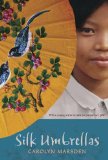
Silk Umbrellas

Noi’s family is suffering because demand for housing is destroying their agrarian way of life. Developers are buying up farm land in order to build vacation homes for city dwellers and foreigners. Noi’s father, who had always worked in the fields and brought home plenty of food to provide for his family, is now a brick-layer with only intermittent work to rely upon. Noi’s sister Ting is sent to work in a factory to help make money for the family. Because children in her village don’t go beyond grade school, at 11 this will be Noi’s last year of school. She dreams of finding a way to escape her fate of following her sister to the factory.

Marsden’s book was published recently, in 2007. According to a report from the U.S. Department of Labor, the minimum age for work in Thailand should have been raised to 15, which means that Ting would have been working legally. The issue of child labor is certainly an important one for discussion, but the book handles it in such a way that it is not scary or hard to understand. Marsden does an excellent job of helping readers understand the family’s finances in a grade level appropriate way.

This book is on grade level for third grade, but older students may be able to get more out of the subject matter.

Marsden provides a glossary to help with vocabulary (as thai words are sprinkled throughout) but no pronunciation guide.

Sex, Nudity, Dating – None.
Profanity – None.
Death, Violence and Gore – Kun Mere teases Kun Pa about going to cockfights when she knows he is going to play chess. Noi burns her hand on an iron and it blisters.
Drugs, Alcohol and Smoking – Grandmother (Kun Ya) smokes cigars.
Frightening or Intense Things – None, although I kept worrying that the grandmother would die (she doesn’t).

Posted in Middle Grades, Primary Grades | Tagged , | Leave a comment

May Miscellany

Another year, another mish-mosh o’ May.  I have all sorts of books for all sorts of age groups ready to go for this month, not to mention our star of the moment, The Hunger Games.  So don’t be a stranger, because anything’s game!

Posted in Uncategorized | Leave a comment

The Hunger Games – Plea for Patience

Okay first off, I am not ignoring The Hunger Games.  I have it out from the library right now so that I can do a full review.  In the mean time, I will strongly, strongly, urge you to read it personally before you recommend it to any non-adult type people.  I would also say that if after you are done reading it you still find yourself wanting to recommend it to an eight year old, to please be completely upfront with the child’s parent about the level of violence in the series. I know it’s a hit movie with a relatively nonthreatening PG-13 rating but I will remind you all that books and movies are often different and that families are very different in what they are comfortable allowing their children to read or watch.  And also, there are other amazing things you can recommend for the eight year old which are exciting and interesting and age appropriate.  If you are a parent and you’re looking for guidance, the best advice I can give is to read the book itself or hold out for my review before granting permission, particularly if your child is still in elementary school.

In classrooms across my district, copies of The Hunger Games are appearing on the desks of third and fourth grade students.  Which means this was a conversation that I could not avoid.  I’ve always been really upfront with my students about books, letting them know exactly why I think they should or shouldn’t read something, because I think and hope that it will help them become critical readers one day.  That hopefully they’ll be able to make the judgment call themselves about whether a book has merit or is just for fun or is too hard or not their taste.  And with all that in mind, I sat down my fourth grade group of students for an honest discussion about The Hunger Games and why I, as an adult they know and trust might advise them to wait until they’re older before reading it.

In case you’re unfamiliar, the basic premise of the book is that children must participate in a televised fight to the death. That is exactly as far as I got before one student started crying.  So clearly she didn’t need much convincing to skip it.  But the rest of my class actually had really great insights on why we needed to talk about it.  I have of course, paraphrased them beyond recognition because my memory is a bit sketchy and we had this chat a week or so ago, but the heart of the issues remains the same.

Kid Raised Issue 1: When kids watch or hear something that is not okay again and again, they might start to think it’s okay.

Adult’s Take: No, I don’t think they’re going to start re-enacting the Hunger Games, but a whole lot of studies have been done on desensitization towards violence, enough to know that it’s a real thing.  Many of the studies focus on video game violence, but I don’t think it’s a long shot to include violent books as a concern.

Kid’s Issue #2: Sometimes, I’m totally okay with the level of violence or scary stuff.  But then something happens that’s more violent or scary and it’s not like I can just unread that.

Adult’s Take: This issue of  no give backs is a real one and one I recall from my own childhood.  I read Hiroshima as required for school when I was in eighth grade and it affected me very strongly.  I carried those images in my mind (still do) because once it’s out there you can’t unknow it.  I did of course counsel them to go tell an adult if this happens and talk about it, but in my overprotective way, I’d rather they didn’t have to feel that way at all.

Kid’s Issue #3: Sometimes I’m totally fine about something and I tell my parents that I can handle it because I really believe I can.  But later, I have nightmares or I get really worried and can’t stop thinking about it.

Adult’s Take: Kids are counting on us to set boundaries for them, to help them decide what they can and can’t handle.  It’s a big burden to place on a child’s shoulders – Are you okay with this? While I certainly want them to be able to make that judgment for themselves someday, for pre-teens they simply may not be ready to choose what’s best for them.

Kid’s Issue #4: Sometimes kids do things because their friends are doing it even if they know it’s wrong or not the best idea. Lots of kids are reading this now and it can be hard to be left out.  Sometimes I make bad decisions for myself when I don’t want to be left out.  I might not be honest with my parents about how something makes me feel if I want to be allowed to keep doing it.

Adult Take: Kids need our help knowing how to deal with peer pressure, even if it’s in dealing with a cool book.  Making sure your kid knows whether or not they can read it and your reasons will help.  Going over things they can tell their friends is even better.  If you’re dealing with a particularly peer-pressure prone child, consider taking the blame for them, you are the grown up after all.

Things kids can say:
I’m saving that for later.
I’m not really interested in that kind of book.
My parents won’t let me.
I think I’ll like it better when I’m older.
I’m really into (insert name of age appropriate book here) right now, so I’m going to be reading that instead.
Sounds interesting.

Kid’s Issue #5: I don’t know that I can understand a book that’s meant for high school kids.

Adult’s Take: My students have been listening to me!  With their advanced vocabularies and great reading comprehension they can often understand books written for much older audiences.  But they also know that comprehension goes much deeper than just being able to tell what is happening.  It means being able to predict what will happen next based on plot and on genre.  It means analyzing the author’s purpose and examining the theme.  It means knowing what techniques the author uses to achieve the desired effect and critiquing how well that is done.  It means making connections to real world events and problems as well as other literature.  They know that doing all that means putting a lot of work into a book, and that sometimes, that work will be easier to do if they are just a little bit older.

In another few months, another book will be the latest, greatest, hottest, coolest.  The Hunger Games can wait.  I will be writing a full review (either this month or next) so you can decide if it’s right for your audience, but for now, I urge you to use caution and make sure you are fully informed before you make any decisions.

Posted in Uncategorized | 4 Comments

Mindblind

Mindblind by Jennifer Roy

Nathaniel Clark has Asperger’s Syndrome.  He also has friends, a jerk of a father, an incredibly loving mother and a completely normal crush on a girl.  While navigating high school social life is a bit different for him than it is for others his age, he manages quite well for himself.  His father’s relentless pushing ends up putting Nathaniel in a dangerous situation but this isn’t the only focus of the book.

I thoroughly enjoyed being a part of Nathaniel’s world and perception of things.  Roy attempts to capture the both the parts of Nathaniel’s life that are essentially the same as his peers, the parts that are significantly different due to his incredible intelligence and also  tries  to show what it must be like when Nathaniel is shutting down and withdrawing from life. It’s interesting to see all these different facets of Nathaniel’s personality.

There were two parts that felt off, one was a sort of bizarre coincidence in which everyone pretty much is going to the same Bat Mitzvah.  The realization of this is based on insufficient information which makes you wonder if they all only know one Jewish person, or if only one person in their town has ever turned 13.

Also, far more importantly, at one point in the book parents supply teens with drugs and alcohol.  They end up facing very stiff penalties for this, in part due to children reporting them to the police.  While it would be nice to think that most adults face consequences for this type of behavior the fact is that more frequently they get away with it, and many teens would not turn in adults engaging in this type of enabling.

Sex, Nudity, Dating – Nathaniel has a crush on a girl (says he’s in love with her).  Parents are divorced, father remarried.  He asks a girl if they’re on a date, but she’s not allowed to date until she is 16. Girls call him a hottie. Molly wants to kiss her boyfriend; they nuzzle.  Nathaniel kisses a girl while drunk.  While being goofy Cooper says that Algebra wears a bra and math is sexy.  Nathaniel dreams of a girl kissing a guy.
Profanity – “sucker/sucka,” “retard,” “dumb,” “dang,” “g.d.” “idiot,” “ass,” “doofus,” “what the H,” “jerk,” Nathanial’s dad uses words “rated PG-13 and R”.  Several times he’s quoted as saying (R-rated word), “asp-hole” clearly a play on “asshole”, “geekloserklutzdorkidiot,” “brat,” “darn,” “wiseass,” The lyrics of rap songs are described as misogynistic and profane. “hell,” “crap,” “bullsh**”,
Death, Violence and Gore – They play a video game and yell die at the enemy.  Evidently, Isaac Newton once stuck a needle in his eye socket just to see what would happen.  Nathaniel hits himself in the head.  A lego Star Wars character is decapitated.
Drugs, Alcohol and Smoking – When dropping Nathaniel off at a party his father tells him no drinking, no drugs.  He does take prescription medications.  The party includes teenagers drinking beer and the chaperones smoking cannabis.  Nathaniel unknowingly drinks punch that has been spiked with vodka.  He is told that it is “just fruit punch.”  It has a very severe effect on him due to his prescription medications.
Frightening or Intense Things – Nathaniel’s father starts by telling his mother not to baby him so he’ll grow up. He tells him he looks like an idiot when he is messy and asks him if he is stupid and other charming things. A boy who mocks him refers to Nathaniel as “Ed.  Special Ed”.  After drinking Nathaniel retreats into himself.  His parents and doctors are concerned he is on the verge of a psychotic break.  They ask him to become more responsive or they will have to hospitalize him for better care.


Posted in Teen, Tween | Tagged , , | Leave a comment

Here’s How I See It, Here’s How It Is

Here’s How I See It–Here’s How It Is by Heather Henson

Junebug is having a rough summer.  Usually it’s her favorite time of year, her family coming together to put on plays at the summer playhouse her father runs.  Usually, the theater is the only place where she feels she belongs, during the school year she’s an outsider, a weirdo, but at the theater she feels a part of something special. But this year is different.  Her mother has moved back to her grandmother’s farm and her father is completely entranced with a much younger actress.  Her older sister Stella is getting ingenue roles while Junebug works props and runs errands for the cast.  But her summer is even more threatened when a know-it-all boy shows up.  At first she doesn’t mind his stutter and encyclopedic knowledge of the theater too much, but when she realizes her father is spending more time with him than he is with her, she becomes jealous and it brings out the worst in her.

Each chapter starts with Junebug’s wish about how her life would be followed by the trials and tribulations of her actual existence.  I thought this would irritate me but the daydream parts are brief enough that they don’t interfere with the rest of the story.  While the character with Asperger’s Syndrome is not a major part of the book, Junebug’s understanding of what it is to be different follows a trajectory that many readers will understand.

Great for: Theater kids.  All wanna-be stage actors will enjoy the theater rich world created by Henson with it’s myriad of Shakespeare references. Junebug’s role as the ignored younger sister will also speak to some.  That said, I’m not sure this has a huge audience, as it reads a bit young for teens, and yet teens are the most likely to have the theater knowledge shared within.

Sex, Nudity, Dating – Junebug’s mother’s pregnancy is mentioned.  Junebug’s parents have separated, and Junebug spends a lot of time wondering if her father is involved with someone else, or if there are other reasons for the split.
Profanity – “weirdo”, “merde” which they explain is French for …. (the ….never being filled in, but just so you know, it’s French for shit), “stupid,” “dumb,”
Death, Violence and Gore – The book opens with Junebug’s father being taken away on a stretcher after suffering a heart attack.  There are prop daggers and swords.  Mama Duvall shoots moles. In telling about past events, Junebug explains that her grandfather died of a heart attack.  Because it’s about the theater, there are references to various deaths/murders in other plays, like MacBeth or Medea’s murdering of her own children or a character in The Seagull committing suicide, a play where a man allows his wife to die in his place. There’s a brief aside about a goat who lost it’s mother.  In discussing playwrights, they mention that Marlowe was killed in a brawl.  Another character has a parent who died in a car accident.
Drugs, Alcohol and Smoking – Junebug fetches cigarettes for someone.
Frightening or Intense Things – Junebug’s parents separate but do not divorce.  The fact that the reconcile may put some parents off of this book since many couples do not reconcile and they may not want to raise false hopes.

Posted in Middle Grades, Tween | Tagged , , , , | Leave a comment

The Curious Incident of the Dog in the Night-Time: A Novel

The Curious Incident of the Dog in the Night-Time by Mark Haddon

When this book was released in 2003, it collected various awards and before long became an international best-seller.  The odd thing is, within the pages of the book, Haddon never mentioned that the character has Asperger’s Syndrome or autism. That information is contained in the dust jacket of the book, and is widely accepted as the explanation behind the main character’s behavior and thought patterns. Supposedly, Haddon himself gets a bit cranky when people make a big deal about it or ask him to speak on autism or complain about inaccuracies in the character’s depiction. While I get his point that labels aren’t really important, what is important is to convey the feelings Christopher has about being different, I still must point out “Sir, if you don’t want people to think you’ve written a book about a character with autism, then don’t write a book where most of the signs point to the main character having autism.” That is all.

Christopher is both upset and curious when he find his neighbor’s dog stabbed to death with a garden fork. His efforts to uncover the truth about what happened to Wellington lead to many other discoveries about himself and his own life.  Written from Christopher’s perspective and often in a stream of consciousness style, this is engaging, and at the time of publication was quite original. Despite numerous other options when reading about characters with neurological differences, this remains a good read.

NB: Teachers who were hoping to use this in the classroom, please see below and carefully note the extensive use of the f-word.  You may want to clear this with the powers that be at your school before you start writing lesson plans.

Due to the language primarily, I would say this should be reserved for mature teens. Most libraries have this filed as adult fiction, but I do think with a teen protagonist that it would be interesting for a ya audience.

Sex, Nudity, Dating – Siobhan explains that raising an eyebrow can mean “I want to do sex with you.”  Christopher mentions a jacket of his mother’s had a label on the left bosom. Christopher explains Stranger Danger as when a stranger tries to lure you into your car to have sex with  him.  A man wears a t-shirt that reads “Beer Helping ugly people have sex for over 2,000 years.”  Mrs. Shears is divorced but sometimes stays over at Christopher’s house.  A parent of Christopher’s had an affair.  Sex is mentioned in that context.  In talking about The Hound of the Baskervilles Christopher talks about how some of the characters run away to do sex.  He finds a porn magazine in his father’s room.  A paper has an article titled “Call Girl Shame” and shows a picture of a girl in a bra.
Profanity – “fuck” repeated multiple times,  “fucking,” “holy fucking shit” “Christ’s sake,” “shit,” “shitting,” “crap,” “bugger,” “hell,” “bloody,” “for God’s sake,” “spazzer,” “spaz,” “crip,” “mong,”  “Jesus Christ,” “arsehole,” “bollocks,” “cunt,” “Jumping Jack Christ” “bastard,” “damn,”
Death, Violence and Gore – The opening of the book contains a detailed description of a dead dog, as well as speculation about its cause of death.  Christopher hits a policeman.  All possible weapons are removed from his person at the police station. Christopher points out that if the universe explodes people will be burned to death.  Christopher names the people in his family who are dead.  His mother was taken to the hospital with a heart problem and died two weeks later of a heart attack.  A neighbor died of an aneurysm. There’s a detailed description of death and decomposition. There’s also a description of cremation.  Christopher once hit someone hard enough to knock her unconscious.  He also carries a Swiss army knife which he says is sharp enough to saw off someone’s fingers.  Christopher says that if people try to hurt him he can kill them and it will be self-defense.  The plot of Hound of the Baskervilles is recounted, and with it all of the death and violence that is in that book:  death, throats being torn out.  Sometimes his mother hit him.  His mother hit his father.  When his father grabs him, he doesn’t like it and hits his father hard.  His father ends up bleeding and with a ripped shirt.  Christopher explains that some people believe in ghosts.  Christopher’s favorite dream (and day dream) involves nearly the entire world dying. His pet rat dies.
Drugs, Alcohol and Smoking – Christopher says his father sometimes drives after drinking.  Christopher does not talk to the next door neighbors because his father says they take drugs. Christopher believes people inject drugs behind the public toilets in the park.  His mother smoked.
Frightening or Intense Things – There is a brief mention of a grandmother with senile dementia.  Christopher was a difficult child and his mother would say things like “I am seriously considering putting you in a home,” or “You are going to drive me to an early grave.”  Christopher’s father asks him “how stupid are you?”  There are several other places where his parents say pretty unconscionable things to him.  A major plot point of the book is the calculated deception of a child by one of his parents.  I’d be happy to explain more (spoiler to your heart’s delight) if you contact me, but don’t want to ruin it for other readers.
Other Considerations: Christopher does not believe in heaven.

Posted in Mature Teen, Teen | Tagged , | Leave a comment